Artificial intellegence for business

During my Artificial Intelligence for Business course, I developed a concept for an AI-powered brain–computer interface (BCI) prosthetics company called Remerge. The project explored how artificial intelligence can be leveraged to streamline everyday business processes, enhance decision-making, and support innovative product launches. Through this work, I combined technical creativity with strategic business applications, designing workflows that demonstrated both the potential of AI in healthcare technology and its role in shaping efficient, future-focused enterprises.
Company AI Ethics Report
I authored an AI Ethics report for my organization, outlining our perspective on artificial intelligence and providing clear guidance for its responsible use in daily operations. The report introduces a comprehensive ethical framework that emphasizes human oversight, bias mitigation, and eco-conscious AI design. It also aligns AI practices with our core organizational values of integrity, respect, and community impact, ensuring that technology enhances human dignity while advancing clinical outcomes.
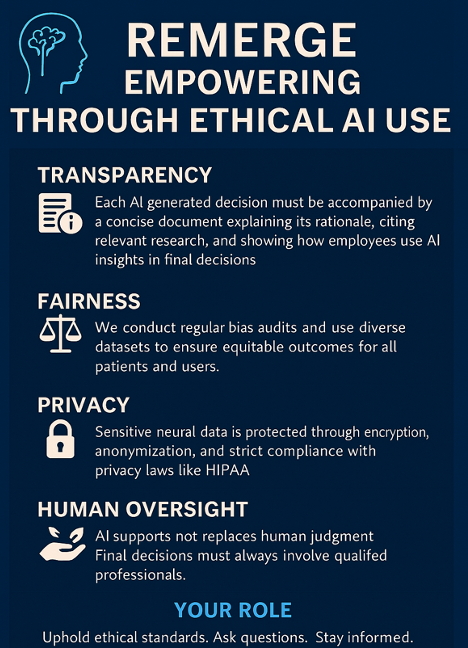
Company Ai use infographic
AI Strategic Plan Video
I developed a comprehensive AI strategic plan and produced a professional video presentation using Synthesia to communicate the vision. The strategy focused on integrating AI across three organizational levels—individual productivity, specialized roles and processes, and product and customer engagement. Using my fictional company Remerge as a case study, I outlined how AI tools like Copilot enhance workflow efficiency, support marketing ideation while maintaining human creativity, and improve patient interaction through personalized chatbot systems. This project demonstrated my ability to design ethically responsible AI strategies, communicate technical concepts effectively, and leverage emerging tools for executive-level presentations.
AI in marketing
I used ai assistance and personal research to help me create a short video talking about ai use in the medical field to help educate fellow students.
Additionally, I developed a rapid-turnaround marketing campaign concept designed to simulate pitching a new business idea to the Shark Tank investors. The project required creating a complete campaign package within one session, including a brand aligned product concept (generated using Ai), target market analysis, SMART objectives, and a compelling campaign hook. I integrated both traditional and digital channels with AI-driven tools such as chatbots, personalization engines, and predictive analytics in my marketing plan to maximize audience engagement. In addition, I outlined a creative strategy with sample promotional materials (generated by Ai), set key performance metrics (CTR, conversion rate, ROI), and built contingency plans to address potential risks. This assignment strengthened my ability to combine creativity, structured planning, and AI-enhanced solutions under strict time constraints skills highly relevant to modern marketing and business development.
AI Business Financial Forecasting Model
I developed a financial forecasting model for a fictional biomedical company, Remerge, which designs and manufactures AI-powered brain–computer interface prosthetics. Using Microsoft Copilot, I generated realistic financial data including monthly revenue, expenses, and net profit over a six-month period. I then applied moving average and trend analysis techniques to forecast future performance, visualizing the results through structured data tables and charts. This project demonstrated my ability to integrate AI tools with business analytics to produce accurate, data-driven financial insights, an essential skill for modern decision-making and strategic planning.
AI Process Optimization Plan
I developed an AI-driven process optimization plan focused on predictive maintenance for brain–computer interface (BCI) prosthetics. The objective was to transform a reactive, technician-dependent maintenance process into a proactive, data-driven system. I identified key operational pain points, mapped existing workflows, and proposed an AI-enhanced model that leverages real-time sensor data, predictive analytics, and natural language processing to detect anomalies and schedule maintenance automatically. The proposed implementation included integration with cloud-based AI platforms and IoT-enabled devices, resulting in projected improvements such as a 40–60% reduction in unexpected device failures and a 30% increase in device lifespan. This project highlights my ability to apply AI solutions to complex engineering systems while balancing innovation, efficiency, and ethical risk management.
AI Customer Service Chatbot
I designed and developed “Remerge chatbot” a customer service chatbot prototype built using Microsoft Copilot. The project focused on simulating real world customer support interactions for a my made up company, incorporating a friendly yet professional tone to ensure accessibility and trust. I created a structured knowledge base with curated FAQs, standardized responses, and embedded resource links to provide instant, accurate information to clients about consultations, insurance coverage, event updates, and more. By integrating this knowledge base into Copilot, the chatbot could autonomously manage scheduling inquiries and client communications. This project not only enhanced my technical skills in AI driven automation but also deepened my understanding of ethical AI design, user experience optimization, and business communication strategy.
The use of AI in hr
I explored the role of artificial intelligence in modern hiring practices through the case study of HireVue, a digital recruitment platform. I examined how AI technologies, including natural language processing and machine learning, enhance efficiency by automating candidate screening, streamlining administrative tasks, and supporting data-informed decision making. The analysis highlights how AI addresses key challenges in high-volume hiring while also raising important ethical considerations around bias, transparency, and data privacy. What stood out most was the extent to which AI has reshaped a traditionally human-centered process, offering both opportunities for innovation and a need for responsible oversight. This work underscores the growing impact of AI in human resources and the importance of balancing technological advancement with fairness and accountability.
Future of AI paper
This research paper, The Future of Work in the Age of AI, explores how artificial intelligence is transforming modern industries, reshaping job roles, and redefining the relationship between humans and technology. Through analysis of real-world applications such as AI-driven hiring systems, automated forecasting tools, and strategic organizational planning the paper highlights both the opportunities and ethical challenges created by AI integration. Drawing from hands-on class projects, it demonstrates how AI can enhance decision-making, increase productivity, and support human-centered innovation when implemented responsibly. This work reflects my ability to critically evaluate emerging technologies and develop thoughtful, ethical strategies for their use in business and organizational settings.
AI for Business final presentation
This final presentation delivers a comprehensive AI business plan centered on developing BCI prosthetic technologies for medical applications. It demonstrates my ability to combine technical understanding with strategic project planning, covering industry analysis, AI applications, phased implementation roadmaps, resource allocation, and a detailed budget model. The presentation also integrates robust ethical considerations, addressing privacy, transparency, fairness, and responsible data governance in high stakes AI systems. Through this work, I showcase my capacity to design scalable AI solutions, anticipate regulatory requirements, and balance innovation with patient-centered values reflecting both strong analytical skills and a commitment to ethical, real-world AI deployment.